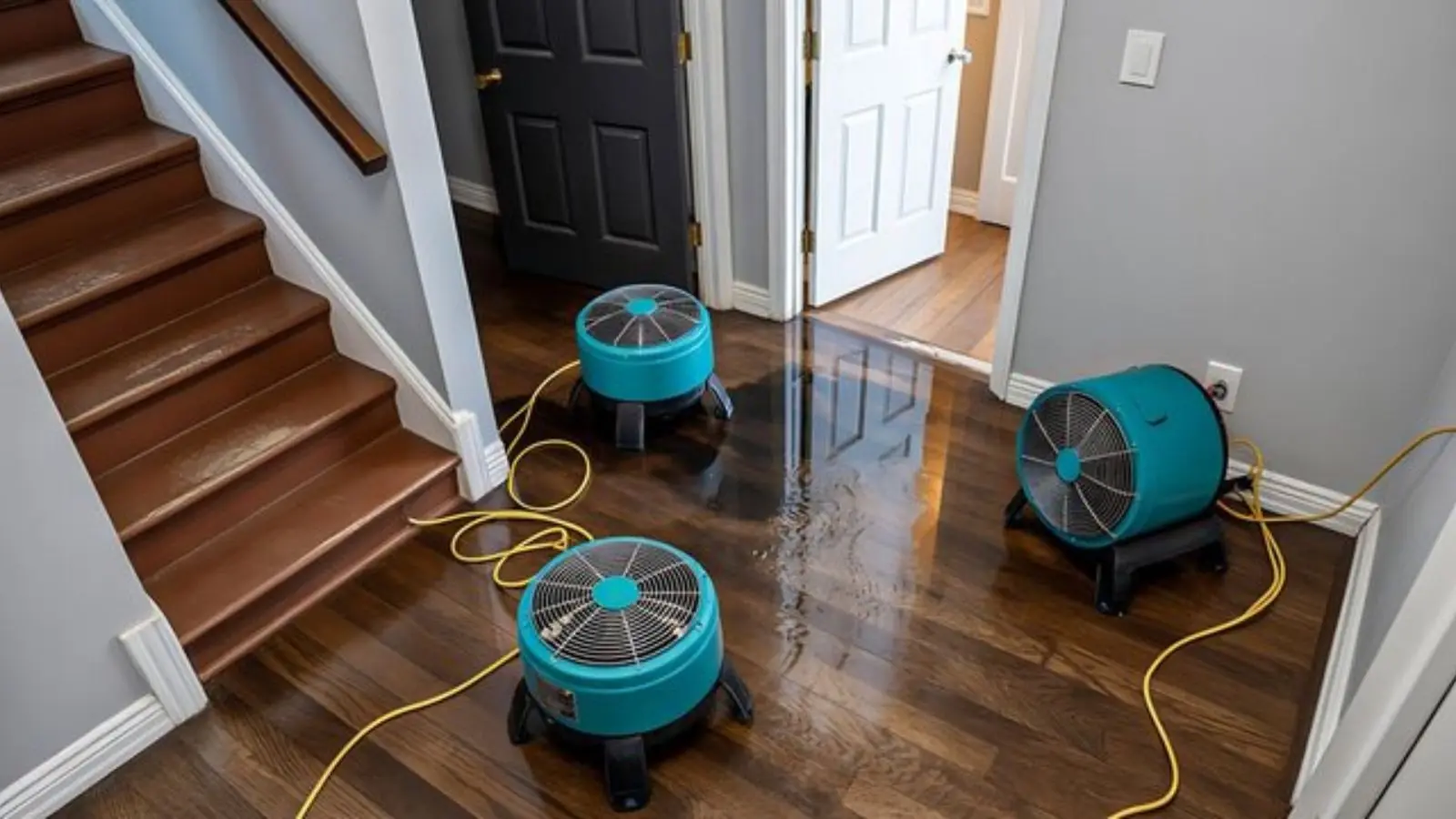
Drying a house after water damage takes as long as it takes the wettest materials to reach normal moisture levels. That depends on how much water got in, what it soaked into, how clean the water was and the humidity inside the house. A crew tracks progress with moisture readings over several visits, and the job ends when the readings say it should, not on a set day.
What drying equipment actually does
Drying is a controlled process, not just running fans. Each piece of equipment handles one part of moving moisture out of the structure.
Air movers
High-velocity fans that push air across wet surfaces. Moving air lifts moisture off floors, walls and cabinets into the room's air.
LGR dehumidifiers
Low grain refrigerant dehumidifiers pull that moisture out of the air and drain it away. Without them, the water just moves from the wall into the air and back again.
Moisture meters
Handheld tools that read how wet drywall, wood and subfloor are. A crew compares them to a dry reference reading from the same type of material.
Thermal imaging
A camera that shows temperature differences, which can point to wet areas behind surfaces. It guides where to take meter readings and does not replace them.
Why fans from a hardware store fall short
A box fan moves air, but it does not remove moisture from the room. Without a dehumidifier, humid air hangs around and wet materials slow down. In a closed house on a muggy day, fans alone can push moisture into dry areas.
Hardware store fans also cannot tell you what is happening inside a wall or beneath flooring. Moisture meters do, and they are the reason a professional dry-out has an end point instead of a guess. Mold can start within about a day, according to the Texas Department of Insurance, so a half-dry house is a risk.
We do not offer equipment rentals. Our drying work comes with the people who place the equipment, monitor it and decide when materials are dry.
Water still spreading?
Our 24/7 line is answered at any hour. Call (817) 623-9267 and describe what you see.
Factors that set the number of drying days
| Factor | Why it matters |
|---|---|
| Water category | Clean supply water is handled differently from contaminated water, and some materials must be removed rather than dried |
| Amount and duration | More water and longer contact means deeper moisture in the structure |
| Materials | Hardwood, tile, carpet pad, drywall and insulation hold and release water at different rates |
| Square footage affected | A larger area needs more equipment and more time to balance |
| Indoor humidity | Wet air slows evaporation, dry air speeds it |
| Access to wet cavities | Water inside walls, under cabinets and below flooring dries slowly unless it is opened up |
| Airflow and equipment placement | Poor placement leaves pockets of moisture that stay wet |
Notice that none of these factors is a promise. A crew can give you a plan after seeing the house, but the plan adjusts as the readings come in.
Summer humidity, winter dryness
The National Weather Service describes July and August as the hottest months in the Fort Worth area, with highs usually in the 90s and often 100 or more. Air conditioning runs hard then, which pulls some moisture out of indoor air. But outdoor humidity can still be high on stormy days, and a house kept closed and cool holds that moisture.
Winter air is often drier, which helps evaporation, but a house with the heat off after a freeze can sit cold and slow. Cold surfaces release water slowly. Neither season guarantees an easy dry-out, so the crew adjusts to conditions each day.
Two houses with the same size leak can dry on very different schedules. A kitchen with tile and a concrete slab sheds water differently than a bedroom with carpet over pad over plywood. The crew learns this by reading the materials, which is why a phone estimate of days is guesswork.
Expect a crew to visit more than once. Each visit checks the readings, moves equipment and decides whether a wet spot needs opening up. These visits are how the job gets an end point you can see on paper.
What a typical dry-out looks like
- Remove standing waterPumps and extractors take out free water first so evaporation can begin.
- Take readingsThe crew maps wet areas with meters and thermal imaging, then records starting numbers.
- Remove what cannot drySoaked carpet pad, saturated insulation and some drywall come out. Scope is explained before the work starts.
- Place equipmentAir movers and dehumidifiers go in where the readings point, with doors and windows kept closed.
- Recheck and adjustReadings are taken again, and equipment moves or comes out as areas reach normal levels.
- Confirm dryThe job ends when materials read dry compared with a reference, not when a number of days has passed.
What you can do while it dries
- Keep doors and windows closed so the dehumidifiers work on the wet area.
- Leave equipment running and do not unplug it to charge a phone.
- Keep children and pets away from cords and hot exhaust.
- Write down your questions for the next visit.
- Tell the crew if you smell mustiness or see new stains.
Ask for the readings in writing. A simple log of the starting numbers, the daily numbers and the dry reference gives you a record to share with your insurer and a clear sense of why the crew is staying or leaving.
What to Do Before a Crew Arrives
Before repairs begin, the structure has to be safe and dry. These steps protect you and keep the record clear.
- Shut off the main water valve if the source is plumbing.
- Turn off power to wet areas only if you can reach the panel without standing in water.
- Do not use ceiling fixtures under a sagging, wet ceiling. Keep people out of that room.
- Do not remove wet materials until they are photographed.
- Keep receipts and photos for your insurer.
Limits worth knowing
Drying cannot fix every material. Water category matters, and contaminated or long-soaked materials often have to be removed instead. Following the published ANSI/IICRC S500 standard guides water damage work, and homeowners can ask any company whether its crews work to it.
Drying is also not waterproofing. If water keeps entering from the outside, the cause needs a separate fix. The rebuild stage after drying is covered by our water damage repair service.
Our water damage cleanup team handles wet material removal. Homes in Euless and Haltom City see the same drying questions after storms and failed lines.
Call us to describe what got wet. We will explain what the drying plan would involve and how the progress is tracked.
Frequently Asked Questions
Not reliably. Drywall can feel dry at the surface while the lower part and the framing stay wet. A moisture meter reads what your hand cannot.
Drying is gradual, and stopping early lets moisture settle back into materials. Equipment stays on until readings come down, and the crew then removes it.
No one can promise that. Mold needs moisture, so drying quickly reduces the conditions it needs, but the outcome depends on the materials and how soon drying began.
Yes. Contaminated water changes what can be kept and how work is done. Some materials come out instead of drying in place.
It can help or hurt. Heat speeds evaporation, but humid air slows it, so the crew follows readings instead of the weather forecast.
Drying in Hurst's Climate
North Texas weather swings between wet springs and falls, hot summers and the occasional hard freeze. The National Weather Service says spring and fall are typically the wettest periods, mostly from thunderstorms. A home that takes on water in those seasons may dry in more humid air, so ask the crew how weather is affecting the readings.
The City of Hurst floodplain page says FEMA has mapped stream flooding but localized street and yard flooding has not been mapped. If water entered during a storm from the yard or street, the cause needs checking before drying can be called finished. Check the FEMA flood map for your address and ask the City of Hurst Engineering Division about flood zone information.
Sources: National Weather Service Fort Worth, City of Hurst floodplain page, Texas Department of Insurance.